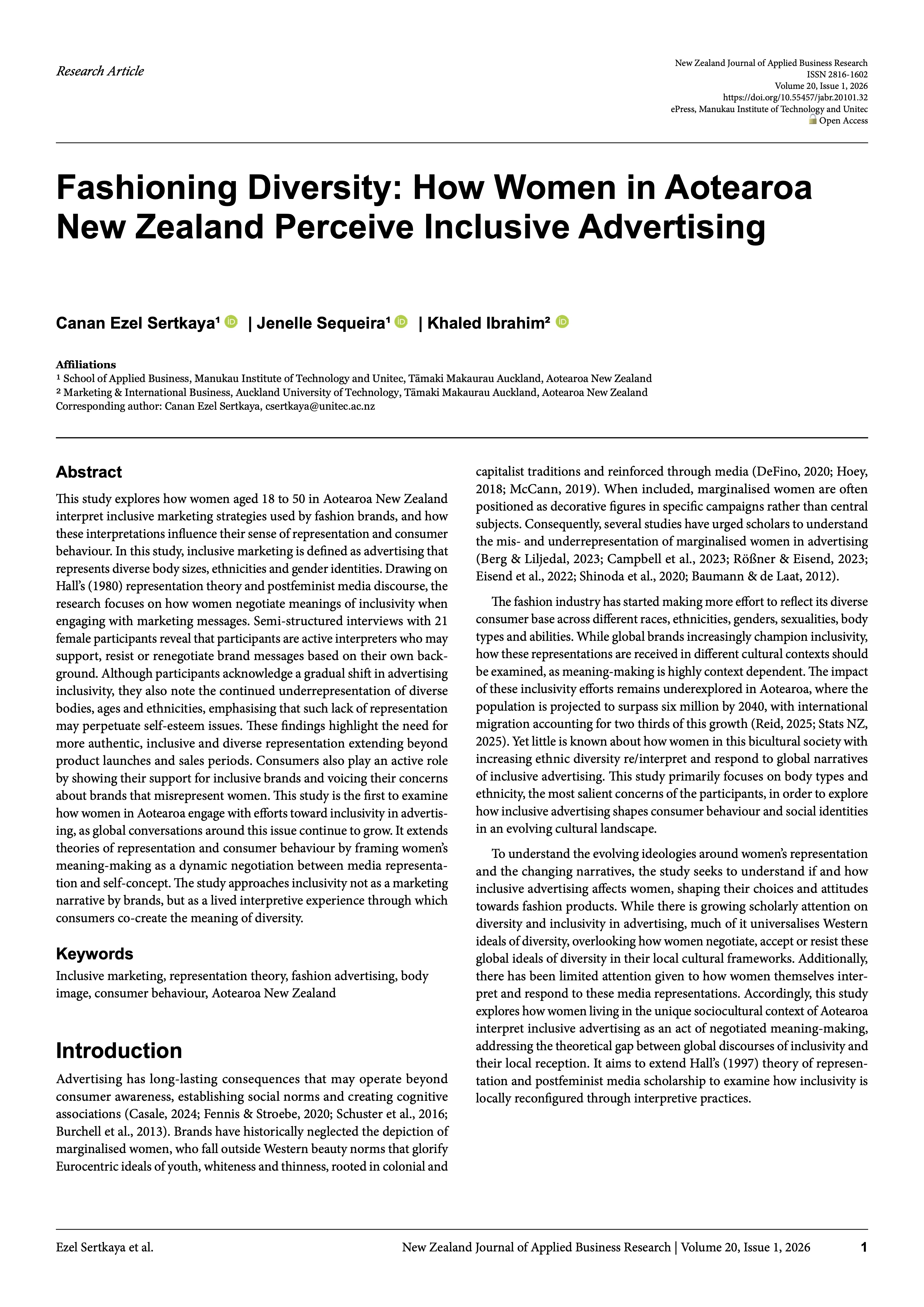
Fashioning Diversity: How Women in Aotearoa New Zealand Perceive Inclusive Advertising
Article Sidebar
Main Article Content
Abstract
This study explores how women aged 18 to 50 in Aotearoa New Zealand interpret inclusive marketing strategies used by fashion brands, and how these interpretations influence their sense of representation and consumer behaviour. In this study, inclusive marketing is defined as advertising that represents diverse body sizes, ethnicities and gender identities. Drawing on Hall’s (1980) representation theory and postfeminist media discourse, the research focuses on how women negotiate meanings of inclusivity when engaging with marketing messages. Semi-structured interviews with 21 female participants reveal that participants are active interpreters who may support, resist or renegotiate brand messages based on their own background. Although participants acknowledge a gradual shift in advertising inclusivity, they also note the continued underrepresentation of diverse bodies, ages and ethnicities, emphasising that such lack of representation may perpetuate self-esteem issues. These findings highlight the need for more authentic, inclusive and diverse representation extending beyond product launches and sales periods. Consumers also play an active role by showing their support for inclusive brands and voicing their concerns about brands that misrepresent women. This study is the first to examine how women in Aotearoa engage with efforts toward inclusivity in advertising, as global conversations around this issue continue to grow. It extends theories of representation and consumer behaviour by framing women’s meaning-making as a dynamic negotiation between media representation and self-concept. The study approaches inclusivity not as a marketing narrative by brands, but as a lived interpretive experience through which consumers co-create the meaning of diversity.
Article Details

This work is licensed under a Creative Commons Attribution-NonCommercial 4.0 International License.
Authors retain copyright ownership of their work. NZJABR owns copyright in the final formatted and published version of the authors’ work.
Articles published in NZJABR since 1 December 2023 are published under a Creative Commons Attribution NonCommercial license 4.0 International. Readers have immediate free access to the articles and are permitted to read, download, copy, distribute, print, search, or link to the full texts of articles, crawl them for indexing, pass them as data to software, or use them for any other lawful purpose, provided that:
- They must give appropriate credit to the authors, and to NZJABR as first publisher, provide a link to the license, and indicate what changes if any they have made, while avoiding any suggestion that the authors or NZJABR endorse their use of the work.
- They may not use the content for commercial purposes.
Plaudit




References
Abitbol, A., & Sternadori, M. (2016). You act like a girl: An examination of consumer perceptions of femvertising. Quarterly Review of Business Disciplines, 3(2), 117–138. https://www.researchgate.net/publication/308795803_YOU_ACT_LKE_A_GIRL_AN_EXAMINATION_OF_CONSUMER_PERCEPTIONS_OF_FEMVERTISING
Adobe. (2019, June 25). Diversity in advertising 2019. https://www.adobe.com/content/dam/cc/au/newsroom/pdf/archive/2019/Adobe_diversity_in_advertising_press_release_FINAL.pdf
Afterpay. (2023, November). A new era of New Zealand fashion. https://afterpay-newsroom.yourcreative.com.au/wp-content/uploads/2023/10/A-NEW-ERA-OF-NEW-ZEALAND-FASHION.pdf
Åkestam, N., Rosengren, S., Dahlén, M., Liljedal, K. T., & Berg, H. (2021). Gender stereotypes in advertising have negative cross-gender effects. European Journal of Marketing, 55(13), 63–93. https://doi.org/10.1108/ejm-02-2019-0125
Alfaro-Ibáñez, B., & Gallardo-Echenique, E. (2023). Femwashing or femvertising? A look at advertising authenticity. In Proceedingsof the International Conference on Communication and Applied Technologies 2023 (ICOMTA 2023) (pp. 111–121). Atlantis Press. https://doi.org/10.2991/978-94-6463-254-5_12
Alkan, N. (2016). New trends in the representation of women in contemporary media culture: A critical analysis of three women empowering advertising campaigns. Galatasaray Üniversitesi Iletişim Dergisi, 24, 119–143. https://doi.org/10.16878/gsuilet.258974
American Eagle. (2025, July 23). Sydney Sweeney has great jeans | American Eagle. YouTube. https://www.youtube.com/watch?v=AK8s3iqL99c
Appadurai, A. (1996). Modernity at large: Cultural dimensions of globalisation. The University of Minnesota Press.
Arifin, S. R. M. (2018). Ethical considerations in qualitative study. International Journal of Care Scholars, 1(2), 30–33. https://doi.org/10.31436/ijcs.v1i2.82
Baumann, S., & De Laat, K. (2012). Socially defunct: A comparative analysis of the underrepresentation of older women in advertising. Poetics, 40(6), 514–541. https://doi.org/10.1016/j.poetic.2012.08.002
Bell, E., Bryman, A., & Harley, B. (2018). Business research methods (5th ed.). Oxford University Press.
Berg, H., & Liljedal, K. T. (2023). Why casting older female models is good for advertising: The positive effects of challenging the underrepresentation of older women in ads. Journal of Advertising Research, 63(1), 61–80. https://doi.org/10.2501/JAR-2023-001
Bourcier-Béquaert, B., Chevalier, C., & Moal, G. M. (2021). The old and the beautiful: Senior women’s exposure to models in advertisements and the impact on their identity. Journal of Consumer Marketing, 38(4), 410–419. https://doi.org/10.1108/jcm-07-2019-3324
Braun, V., & Clarke, V. (2006). Using thematic analysis in psychology. Qualitative Research in Psychology, 3(2), 77–101. https://doi.org/10.1191/1478088706qp063oa
Braun, V., & Clarke, V. (2019). Reflecting on reflexive thematic analysis. Qualitative Research in Sport, Exercise and Health, 11(4), 589–597. https://doi.org/10.1080/2159676X.2019.1628806
Brookes, E. (2021, February 24). Ethical fashion’s plus size problem. Stuff. https://www.stuff.co.nz/life-style/fashion/124244236/ethical-fashions-plus-size-problem
Brüchert, A. B., & Kaniki, N. K. (2021). Is fashion for the people loved by all the people? The effects of inclusion in fashion brands on attitude and purchase intention in generation Y consumers [Master’s thesis, Lund University]. Lund University Publications. https://www.lunduniversity.lu.se/lup/publication/9050663
Burchell, K., Rettie, R., & Patel, K. (2013). Marketing social norms: Social marketing and the ‘social norm approach’. Journal of Consumer Behaviour, 12(1), 1–9. https://doi.org/10.1002/cb.1395
Campbell, C., Sands, S., McFerran, B., & Mavrommatis, A. (2023). Diversity representation in advertising. Journal of the Academy of Marketing Science, 53, 588–616. https://doi.org/10.1007/s11747-023-00994-8
Casale, R. (2024). Can you hear me? The inclusive advertising and its representation. PuntOorg International Journal, 9(2), 208–227. https://doi.org/10.19245/25.05.pij.9.2.7
Choy, L. T. (2014). The strengths and weaknesses of research methodology: Comparison and complimentary between qualitative and quantitative approaches. IOSR Journal of Humanities and Social Science, 19(4), 99–104. https://www.researchgate.net/publication/269752866_The_Strengths_and_Weaknesses_of_Research_Methodology_Comparison_and_Complimentary_between_Qualitative_and_Quantitative_Approaches
Commerce Commission. (2021). Consumer behaviour and preferences in the New Zealand retail grocery sector: Consumer study report. https://comcom.govt.nz/__data/assets/pdf_file/0020/260381/Ipsos-Consumer-behaviour-and-preferences-in-the-NZ-retail-grocery-sector-Consumer-study-report-July-2021.pdf
Craddock, N., Ramsey, M., Spotswood, F., Halliwell, E., & Diedrichs, P. C. (2019). Can big business foster positive body image? Qualitative insights from industry leaders walking the talk. Body Image, 30, 93–106. https://doi.org/10.1016/j.bodyim.2019.06.004
DeCarlo, M. (2018). Paradigms, theories, and how they shape a researcher’s approach. In Scientific inquiry in social work. Pressbooks. https://pressbooks.pub/scientificinquiryinsocialwork/chapter/6-2-paradigms-theories-and-how-they-shape-a-researchers-approach
DeFino, J. (2020, October 19). How white supremacy and capitalism influence beauty standards. Teen Vogue. https://www.teenvogue.com/story/standard-issues-white-supremacy-capitalism-influence-beauty
Deguara, B. (2019, April 21). Farmers diverse bra campaign a stark contrast to last year’s photoshop-fail. Stuff. https://www.stuff.co.nz/business/111312917/farmers-diverse-bra-campaign-a-stark-contrast-to-last-years-photoshopfail
Deloitte. (2022, June 15). Authentically inclusive marketing: Winning future customers with diversity, equity, and inclusion. Marketing Association. https://marketing.org.nz/resource-hub/authentically-inclusive-marketing
DiSalvatore, E. D. (2010). Portrayal of women in advertising. https://ellendisalvatore.weebly.com/uploads/1/1/9/9/11996502/research_paper-_revised_women_in_adv.pdf
Dove. (2023, April 9). Project #ShowUs. https://www.dove.com/ca/en/stories/campaigns/showus.html
Dove. (2023, December 15). The Dove Real Beauty Pledge. https://www.dove.com/us/en/stories/about-dove/dove-real-beauty-pledge.html
Drake, V. E. (2017). The impact of female empowerment in advertising (femvertising). Journal of Research in Marketing, 7(3), 593–599. https://www.academia.edu/42075659/The_Impact_of_Female_Empowerment_in_Advertising_Femvertising
Dreska, H. (2023). The impact of diversity, equity, and inclusion in the fashion industry [Honours thesis, Bryant University]. Bryant Digital Repository. https://digitalcommons.bryant.edu/honors_finance/59/
Eisend, M., Muldrow, A. F., & Rosengren, S. (2022). Diversity and inclusion in advertising research. International Journal of Advertising, 42(1), 52–59. https://doi.org/10.1080/02650487.2022.2122252
Fennis, B. M., & Stroebe, W. (2020). The psychology of advertising (3rd ed.). Routledge. https://doi.org/10.4324/9780429326981
Gap. (2025, August 19). Better in denim. YouTube. https://www.youtube.com/watch?v=IwzF26o0AuU
Ghose, A., & Todri-Adamopoulos, V. (2016). Toward a digital attribution model: Measuring the impact of display advertising on online consumer behavior. MIS Quarterly, 40(4), 889–910. https://www.jstor.org/stable/26629681
Gutmann, B., Jha, S., O’Doherty, E., & Banerji, R. (2022). Selling stereotypes: Reviewing the impact of business advertisements on gender norms and socialization. Business and Human Rights Journal, 7(1), 157–162. https://doi.org/10.1017/bhj.2021.48
Hackett, P. M. W., Schwarzenbach, J. B., & Jürgens, U. M. (2016). Consumer psychology: A study guide to qualitative research methods. Verlag Barbara Budrich. https://doi.org/10.2307/j.ctvddzsrf
Hall, S. (1980). Encoding/decoding. In S. Hall, D. Hobson, A. Lowe, & P. Willis (Eds.), Culture, media, language: Working papers in cultural studies (pp. 63–87). Hutchinson.
Hall, S. (Ed.). (1997). Representation: Cultural representations and signifying practices. Sage Publications.
Hallensteins. (2019, February 20). The power of the suit. YouTube. https://www.youtube.com/watch?v=7QxkCK7lvTQ
Hoey, C. (2018, May 16). Representation of women in advertising. The Sydney Feminists. https://www.sydneyfeminists.org/representation-of-women-in-advertis
Husband, G. (2020). Ethical data collection and recognising the impact of semi-structured interviews on research respondents. Education Sciences, 10(8), 206. https://doi.org/10.3390/educsci10080206
Kantar. (2024). Brand Inclusion Index. https://www.kantar.com/campaigns/brand-inclusion-index
Khan, A. (2021). Impact of advertising on consumer buying behaviour. “SANSMARAN” Management Research Journal, 11(1), 32–38.
Kim, S., & Yang, S. J. (2024). Size-inclusive advertising in the Asian fashion market: Female consumers’ responses to a plus-size vs. thin-size model in South Korea. PLOS One, 19(6), e0304989. https://doi.org/10.1371/journal.pone.0304989
Lai, G. (2025, May 21). The Vogue Australian Fashion Week 2025 size inclusivity report. Vogue Australia. https://www.vogue.com.au/fashion/news/afw-2025-vogue-size-inclusivity-report/image-gallery/bf69bb4aee772ba24f9a786694efc7c7
Lee, Z., Alwi, S. F. S., & Gambetti, R. (2024). The thousand faces of beauty: How credible storytelling unlocks disability representation in inclusive luxury fashion branding. Journal of Business Research, 181. https://doi.org/10.1016/j.jbusres.2024.114744
Lenin, R., & Manivannan, P. (2022). The impact of digital advertising on consumer behavior. International Journal on Global Business Management and Research, 11(1), 105–119.
Levy, S. J. (2005). The evolution of qualitative research in consumer behavior. Journal of Business Research, 58(3), 341–347. https://doi.org/10.1016/s0148-2963(03)00107-3
Licsandru, T. C., & Cui, C. (2018). Subjective social inclusion: A conceptual critique for socially inclusive marketing. Journal of Business Research, 82, 330–339. https://doi.org/10.1016/j.jbusres.2017.08.036
Loclaire. (2019). Our story. https://www.loclaire.com/pages/our-story
Lopukhova, O. G. (2015). The impact of gender images in commercials on the self-consciousness of adolescents. Psychology in Russia, 8(1), 100–111. https://doi.org/10.11621/pir.2015.0109
L’Oréal Paris. (2024). Relive the L’Oréal Paris runway show during Paris Fashion Week. https://www.youtube.com/watch?v=IMv-IAFzQlU
Lou, C., & Tse, C. H. (2020). Which model looks most like me? Explicating the impact of body image advertisements on female consumer well-being and consumption behaviour across brand categories. International Journal of Advertising, 40(4), 602–628. https://doi.org/10.1080/02650487.2020.1822059
Madima, S. E. (2024). Gender representation using indigenous African languages in South African television advertisements. In A. Salawu & K. Oyesomi (Eds.), Marketing communication in African languages (pp. 224–236). Routledge. https://doi.org/10.4324/9781003517382
Mardones, G. P., & Ayala, I. S. (2021). Perspectives on diversity and inclusion in the fashion industry. Journal of Gender Studies, 24. https://doi.org/10.6093/1827-9198/8881
McCann, H. (2019, December 8). Look good, feel good. Overland Literary Journal, 237. https://overland.org.au/previous-issues/issue-237/feature-look-good-feel-good/
McKinsey & Company. (2023a, May 22). The beauty market in 2023: A special state of fashion report. https://www.mckinsey.com/industries/retail/our-insights/the-beauty-market-in-2023-a-special-state-of-fashion-report
McKinsey & Company. (2023b, November 29). The state of fashion 2024: Finding pockets of growth as uncertainty reigns. https://www.mckinsey.com/industries/retail/our-insights/state-of-fashion-2024
Middleton, K., & Turnbull, S. (2021). How advertising got ‘woke’: The institutional role of advertising in the emergence of gender progressive market logics and practices. Marketing Theory, 21(4), 561–578. https://doi.org/10.1177/14705931211035163
Mollina, J. (2024, March 14). Size inclusive: An insider’s guide to plus-size fashion in Aotearoa. Fashion Quarterly. https://fq.co.nz/size-inclusive-guide-plus-size-fashion-aotearoa/
Murray, C. (2025, August 12). American Eagle foot traffic falls nearly 9% year-over-year amid Sydney Sweeney controversy. Forbes. https://www.forbes.com/sites/conormurray/2025/08/12/american-eagle-foot-traffic-falls-nearly-9-year-over-year-amid-sydney-sweeney-controversy/
Nell, C. (2013). Exploring the influence of store atmospherics on consumers’ buying behaviour in apparel retail stores: An exploratory study in Tshwane [Master’s thesis, University of South Africa]. Semantic Scholar. https://www.semanticscholar.org/paper/Exploring-the-influence-of-store-atmospherics-on-in-Nell/9599f647b7ba1adbaff0bc77b5eb3b2bdc0a9ad0
Nickerson, C. (2024, February 13). Interpretivism paradigm and research philosophy. Simply Psychology. https://www.simplypsychology.org/interpretivism-paradigm.html
Norville, T. Y., & Viberg, M. (2022). Not so tall, white, and skinny anymore? How the image shift in social media advertising affects young women’s happiness [Master’s thesis, BI Norwegian Business School]. BI Open. https://hdl.handle.net/11250/3034676
Oyatoogun, G. O. (2023). Inclusive fashion for women with mobility disabilities in the UK [Master’s thesis, Mälardalen University]. DiVA Portal. https://mdh.diva-portal.org/smash/get/diva2:1777662/FULLTEXT01.pdf
Paynton, S., & Hanh, L. (2021). Introduction to communication. LibreTexts. https://socialsci.libretexts.org/Bookshelves/Communication/Introduction_to_Communication/Introduction_to_Communication_(Paynton_and_Hahn)
Pervin, N., & Mokhtar, M. (2022). The interpretivist research paradigm: A subjective notion of a social context. International Journal of Academic Research in Progressive Education and Development, 11(2), 419–428. https://doi.org/10.6007/IJARPED/v11-i2/12938
Pešić-Jenacković, D., & Cogoljević, M. (2021). The importance of applying qualitative methods in surveying consumer behaviour and satisfaction. International Review, 3–4, 116–122. https://doi.org/10.5937/intrev2103116p
Peterson, H. (2014, October 31). Victoria’s Secret sparks outrage with “Perfect Body” campaign. Business Insider. https://www.businessinsider.com/victorias-secret-perfect-body-campaign-2014-10
Piaggio, V. (2023, July 27). Learning from the most inclusive brands. Kantar. https://www.kantar.com/inspiration/sustainability/learning-from-the-most-inclusive-brands
Poole, D. (2021, April 20). The power of inclusion and diversity in advertising. Kantar. https://www.kantar.com/inspiration/advertising-media/the-power-of-inclusion-and-diversity-in-advertising
Qayyum, A., Jamil, R. A., Shah, A. M., & Lee, K. (2023). Inclusive advertising featuring disability on Instagram: Effect on consumer well-being, brand engagement, and purchase intention. Journal of Retailing and Consumer Services, 75. https://doi.org/10.1016/j.jretconser.2023.103515
Rehman, F. U., & Zeb, A. (2023). Translating the impacts of social advertising on Muslim consumers buying behavior: The moderating role of brand image. Journal of Islamic Marketing, 14(9), 2027–2234. https://doi.org/10.1108/jima-07-2021-0231
Reid, A. (2025). Migration: The engine driving New Zealand’s population growth. Berl. https://berl.co.nz/economic-insights/migration-engine-driving-new-zealands-population-growth
Richards, E. (2020). 2020 Fellowship: Inclusive marketing. Marketing and communications as a tool for social change. Fuller. https://fuller.com.au/for-good/fellowship/diversity-and-inclusivity/
Rößner, A., & Eisend, M. (2023). Ethnic minorities in advertising. Journal of Advertising, 52(5), 774–784. https://doi.org/10.1080/00913367.2023.2255247
Salen, R. A. (2014). A sense of pride over my size: A qualitative study of women of size who consider themselves body positive [Master’s thesis, Smith College]. Smith ScholarWorks. https://scholarworks.smith.edu/theses/829/
Sandhu, N. (2018). Impact of gender cues in advertisements on perceived gender identity meanings of the advertised product. FIIB Business Review, 7(4), 293–303. https://doi.org/10.1177/2319714518805829
Schuster, L., Kubacki, K. & Rundle-Thiele, S. (2016). Community-based social marketing: Effects on social norms. Journal of Social Marketing, 6(2), 193–210. https://doi.org/10.1108/JSOCM-06-2015-0036
Shao, W., Zhang, Y., Cheng, A., Quach, S., & Thaichon, P. (2023). Ethnicity in advertising and millennials: The role of social identity and social distinctiveness. International Journal of Advertising, 42(8), 1377–1418. https://doi.org/10.1080/02650487.2023.2172663
Shaw, A. (2022, November 27). Fashion fatphobia: Why it’s so hard for plus-size Kiwis to find good clothes. Stuff. https://www.stuff.co.nz/business/130424544/fashion-fatphobia-why-its-so-hard-for-plussize-kiwis-to-find-good-clothes
Shinoda, L. M., Veludo-de-Oliveira, T., & Pereira, I. (2020). Beyond gender stereotypes: The missing women in print advertising. International Journal of Advertising, 40(4), 629–656. https://doi.org/10.1080/02650487.2020.1820206
Stanković, J., Živković, R., Marić, T., & Gajić, J. (2018). Effects of women’s representation in advertising on customers’ attitudes. Marketing, 49(3), 192–205. https://doi.org/10.5937/markt1803192s
Statista. (2024, April 17). Apparel market worldwide – Statistics and facts. https://www.statista.com/topics/5091/apparel-market-worldwide
Stirling Sports. (2019, November 28). Change the game. Prove them wrong. YouTube. https://www.youtube.com/watch?v=Wu_NKSlabyY
StopPress Team. (2021, June 25). How diverse is New Zealand advertising and marketing? StopPress. https://stoppress.co.nz/news/how-diverse-is-new-zealand-advertising-and-marketing/
Stats NZ. (2025). New Zealand’s population likely to reach 6 million before 2040. https://www.stats.govt.nz/news/new-zealands-population-likely-to-reach-6-million-before-2040/
Stuff. (2022, April 28). New survey gives insights on diversity and inclusion in advertising and the media. https://advertise.stuff.co.nz/news/new-survey-gives-insights-diversity-and-inclusion-advertising-and-media
Suradkar, N., & Chanana, B. (2024). A study of inclusivity in the fashion and textiles industry. Journal of the Textile Association, 85(1), 23–28. https://doi.org/10.5281/zenodo.11564271
Taquette, S. R., & Da Matta Souza, L. M. B. (2022). Ethical dilemmas in qualitative research: A critical literature review. International Journal of Qualitative Methods, 21. https://doi.org/10.1177/16094069221078731
The Carpenter’s Daughter. (n.d.). Our story. https://tcd.co.nz/pages/about-us
The Creative Store New Zealand. (2022, August 15). Is your brand marketing truly inclusive? https://thecreativestore.co.nz/creative-talk/ideas/is-your-brand-marketing-truly-inclusive/
The Inclusive Code. (2025). https://the-inclusive-code.co.nz/
Tonti, L. (2024, February 12). Size-inclusive, sustainable brands: Australian fashion professionals share their favourites. The Guardian. https://www.theguardian.com/lifeandstyle/2024/feb/13/size-inclusive-sustainable-brands-australian-fashion-professionals-share-their-favourites
Ünal, D. A., Dirlik, O., & Otamis, P. A. (2012). A qualitative research to explore the purchase behaviour determinants of middle-aged women. Procedia – Social and Behavioral Sciences, 62, 1337–1341. https://doi.org/10.1016/j.sbspro.2012.09.228
Venuto, D. (2022, August 17). Māori tokenism in advertising: Is there a better way to do it? The New Zealand Herald. https://www.nzherald.co.nz/business/companies/media-marketing/maori-tokenism-in-advertising-is-there-a-better-way-to-do-it/OXPJMIC445TZ4OTOAOTKBMJWYE/
Viglia, G., Tsai, W. S., Das, G., & Pentina, I. (2023). Inclusive advertising for a better world. Journal of Advertising, 52(5), 643–646. https://doi.org/10.1080/00913367.2023.2255242
Wiklund, C. (2022). Inclusive marketing: A study of Swedish female consumers’ perceptions of inclusive advertisements in the fashion industry [Thesis, Umeå University]. DiVA Portal. http://www.diva-portal.org/smash/get/diva2:1674096/FULLTEXT02.pdf
Yaghi, M. (2023). Challenging gender stereotypes in advertising: A call for inclusive marketing practices. Social Science Research Network. https://doi.org/10.2139/ssrn.4458094
Zayer, L. T., Coleman, C. A., & Gurrieri, L. (2023). Driving impact through inclusive advertising: An examination of award-winning gender-inclusive advertising. Journal of Advertising, 52(5), 1–19. https://doi.org/10.1080/00913367.2023.2255233
Zhou, M. (2023, September 18). A growing list of Australian and New Zealand labels that cater to beyond a size 16. Fashion Journal. https://fashionjournal.com.au/fashion/size-inclusive-sustainable-brand-directory/